
Blog
Surat Safe City Project: The Fiber Network Behind It
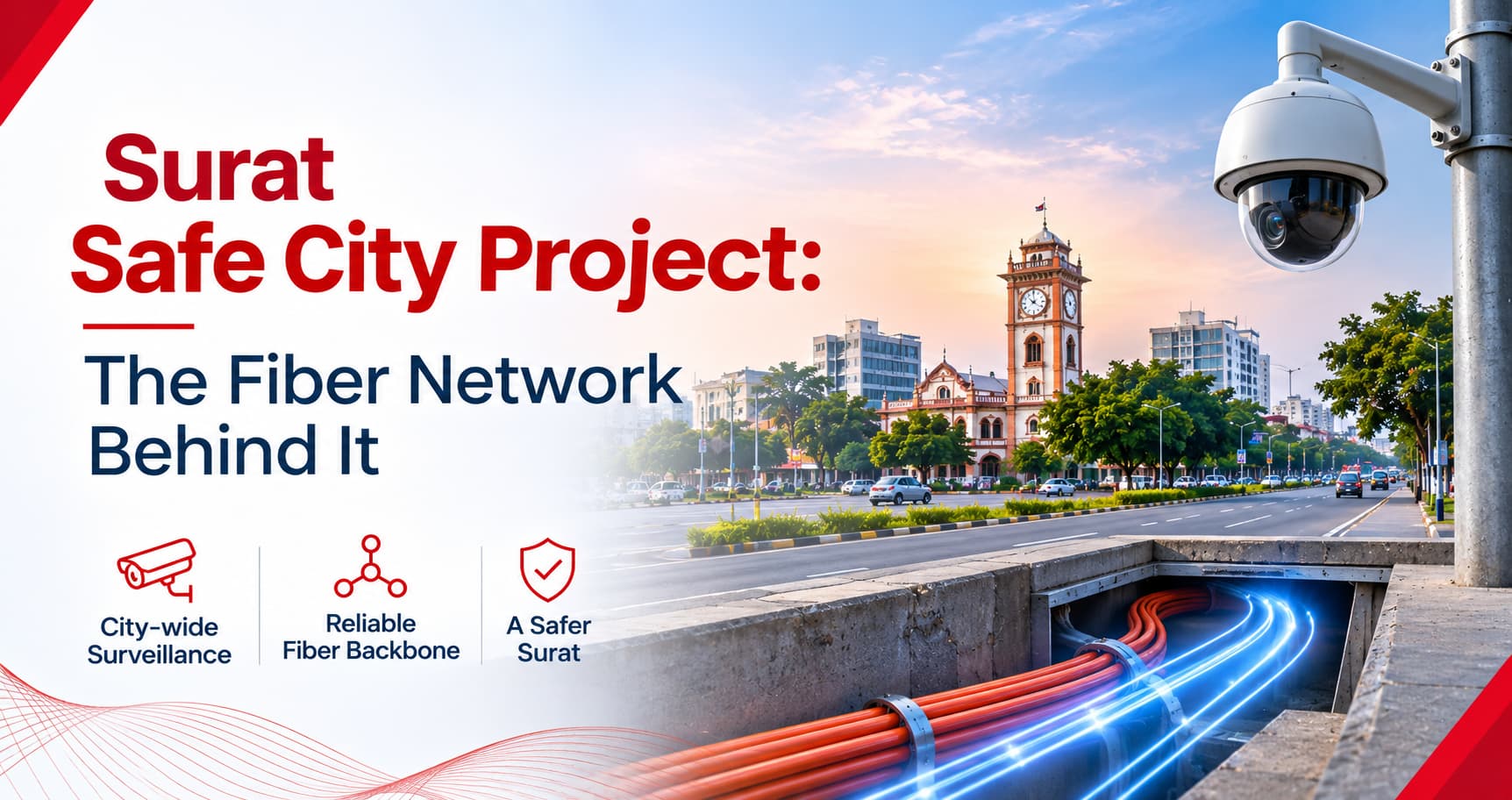
When Surat launched its Safe City CCTV project on 18 January 2013, it became one of the first cities in India to watch its streets from a single command centre. What most people saw were the cameras on poles and the video wall at the police control room. What made it work was underneath the road: a dedicated underground fiber network built and maintained by RK Fibergrid.
This article looks at how that network was designed, why fiber was the only practical choice, and what it means for cities planning their own surveillance systems.
A City-Wide Network Built in Four Months
The project ran in public-private partnership with Surat City Police and the Traffic Education Trust. The whole system, covering fiber laying, network setup and the command centre links, was completed in just four months.
It was delivered in two phases. Phase 1 covered 103 cameras across 21 locations. Phase 2 added 792 cameras across 106 locations. Together they linked 127 points of presence and 491 camera pole locations to the Integrated Command and Control Centre at Surat Police Bhavan.
Why Underground Fiber Was the Right Choice
A surveillance network carries live video from hundreds of cameras at the same time, around the clock. Any break means a blind spot. Wireless links can suffer interference, and overhead cables are exposed to wind, road works and accidental damage.
RK Fibergrid laid the fiber underground, running from each camera pole to the command centre. Much of it was installed using Horizontal Directional Drilling (HDD), which bores beneath roads, bridges and underpasses without digging open trenches. This kept traffic moving during construction and placed the cable well out of harm’s way once the work was done.
How the Network Is Designed
The network follows a ring design, which gives every location a second path if one route is cut.
- A 10 Gbps backbone ring carries traffic between the main points of presence and the command centre.
- A 1 Gbps access ring connects the last-mile camera locations to the backbone.
- Major entry and exit routes into the city, including Kadodara, Kamrej, Palsana, Olpad, Hazira and Amroli, are covered by the underground network.
Because the fiber is dedicated to the project, video does not compete with any other traffic. Feeds reach the command centre in real time, where each police station can also monitor its own area.
Built to Grow With the City
The network was designed to support more than 25,000 cameras, far beyond the original rollout. It can also carry newer applications without major upgrades, such as face recognition, vehicle speed detection and automatic number plate recognition.
The same fiber now supports the city’s e-challan system for traffic violations, public announcement systems at signals, and links to traffic and emergency services. One underground network serves many public services.
Round-the-Clock Monitoring and Maintenance
A surveillance network is only as good as its upkeep. RK Fibergrid’s team monitors the network 24 hours a day and provides field support for both the active equipment and the passive fiber. Fast response keeps cameras online and avoids gaps in coverage.
Lessons for Other Cities
Surat’s experience offers a simple lesson for any city planning a Safe City or Smart City project: decide on the network first. Cameras, sensors and software can be upgraded every few years, but the fiber underneath is meant to last for decades.
- Plan a dedicated fiber backbone rather than relying on shared or wireless links.
- Lay fiber underground wherever possible, especially across bridges and busy junctions.
- Design in rings so a single cut never takes a whole area offline.
- Build in spare capacity for future cameras and analytics.
- Agree on a long-term maintenance model before construction begins.
More than a decade after its launch, the Surat Safe City network shows what a well-planned fiber backbone can do. For RK Fibergrid, it remains a benchmark for how underground fiber can support public safety at city scale.